
Trading in the equity market will largely depend on two major events this week - general elections result and the RBI interest rate decision - analysts said, adding that the benchmark indices may rally on Monday on exit polls' prediction of a massive win for the BJP-led NDA and strong GDP data. Exit polls on Saturday predicted that Prime Minister Narendra Modi will retain power for a third straight term, with the NDA expected to win a big majority in the polls. Counting of votes will take place on June 4.

It is thanks to the policy of liberalisation conceived by Manmohan Singh and enforced by P V Narasimha that the Indian economy has now become the world's 5th largest economy by nominal GDP, asserts Dr Sudhir Bisht.

The Israeli government on Sunday approved the appointment of Reuven Azar as the new Ambassador to India.

Embargo on imports from a neighbouring country would send a chilling signal to foreign investors who look for transparency and companies with manufacturing units in India had requested the government to publish any change in port policy "to provide the business community with the visibility they need to function", says United States-India Strategic Partnership Forum.

India's economy is likely to grow by 6.5 per cent in the current and the next financial year, an EY report said, attributing lower than anticipated expansion in the September quarter to fall in private consumption expenditure and gross fixed capital formation. Real GDP growth eased to a seven-quarter low of 5.4 per cent in July-September -- the second quarter of the current 2024-25 fiscal year.

Addressing party MPs at the general body meeting of the Congress Parliamentary Party in the central hall of Parliament, she said when facing a significant national challenge, it has been the tradition in our country to bring Parliament into confidence.

IT and interest rate-sensitive bank, realty, and auto stocks ended with sharp gains.

Stock markets will be driven by quarterly earnings by index majors, global trends and the RBI's interest rate decision this week after digesting news on budget proposals and US Federal policy outcome, say analysts. The trading activity of foreign investors and the movement of global oil benchmark Brent crude would also dictate trends in equities. "On the domestic front, the MPC (Monetary Policy Committee) meeting is scheduled from February 6-8.

Lavrov said a rupee-rouble payment system for trade with India was put into place earlier and it could be strengthened further.

India's exports may have touched an all-time high of $422 billion in 2021-22 but recession in key western markets and geo-political crisis due to the Russia-Ukraine war are expected to impact the growth of the country's outbound shipments in 2023. All the global trade promoting factors like political stability, movement of goods, adequate availability of containers and shipping lines, demand, stable currency and smooth banking systems are in disarray. Adding to the woes, COVID cases have again started rising in countries like China, Japan, South Korea and the US.

'...you evaluate three key factors before committing your money.'

President Kovind, who arrived in Dhaka earlier in the day on his maiden State visit at the invitation of his counterpart M Abdul Hamid to attend the golden jubilee celebrations of Bangladesh's independence from Pakistan in 1971, held delegation-level talks with him which was followed by a banquet.

'Are we to believe that coordinated moves by the Canadian and US authorities are no longer taking place?', asks Ambassador M K Bhadrakumar.

'If the criminal or civil charges are deemed unworthy or defective, Trump's new justice department and SEC can withdraw the criminal and civil cases.'

From the Sensex pack, JSW Steel, Tata Steel, NTPC and UltraTech Cement emerged as major winners, closing the day with a gain of up to 3.33 per cent. On the other hand, Asian Paints, ITC, L&T and SBI were the laggards, ending the session up to 3.95 per cent lower. Of the 30 Sensex stocks, 14 closed the day in green, while on the 50-stock index Nifty 25 scrips ended with gains.

The employment situation remains dire. Whatever can be done to promote greater low-skill employment should be pursued aggressively, advises former chief economic adviser Shankar Acharya.

From the Sensex basket, Tech Mahindra, Tata Steel, JSW Steel, HCL Technologies, Tata Consultancy Services, Larsen & Toubro and Kotak Mahindra Bank were the biggest laggards. Mahindra & Mahindra, Power Grid, Bajaj Finance, IndusInd Bank and Maruti were the major gainers.

Market players attribute the rally in small and midcaps to flows from retail investors and domestic institutions.

'If Modi were to be elected, he would be part of a coalition government, and within that he would have to take this minority into account. Muslims cannot relate to the idea of Hindu nationalism. Although it is presented as a pan-Indian idea, it appears to them to be exclusive.'

'India needs many more job creators, both in manufacturing and services, to make it big.' 'For that, the red carpet must be rolled out fully and for all investors without holding back,' suggests Nivedita Mookerji.
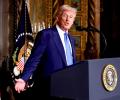
The US is currently Earth's most powerful country and a certain latitude of understanding -- a world view -- is popularly expected from its leadership. From a country identified with freedom, constitution, debate, democracy and the likes of Abraham Lincoln even as it had the most powerful military around, the US, following Trump's actions, seemed repositioned as militarily powerful with other qualities secondary, observes Shyam G Menon.
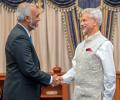
The avoidable stresses and strains in ties helped in one way. It showed for the entire region how a matured India handled diplomatic relations, especially with a smaller and suspicious neighbour, with practised dignity and patience, unruffled by provocations in word, deed and action, observes N Sathiya Moorthy.

A healthy growth in India's services segments has helped the country's total exports and imports of goods and services to cross the $800 billion mark during the first half of 2023, despite a slowdown in global demand, think tank GTRI said in a report on Monday. According to the analysis of the Global Trade Research Initiative (GTRI), exports of goods and services rose by 1.5 per cent to $385.4 billion during January-June this year, as against $379.5 billion in January-June 2022. Imports, however, dipped by 5.9 per cent to $415.5 billion during the six months of this year, as against $441.7 billion in January-June 2022.

'Like Nehru, too, Modi has found dealing with Beijing more and more difficult and has adopted an increasingly assertive approach towards managing India's northern neighbour.'
